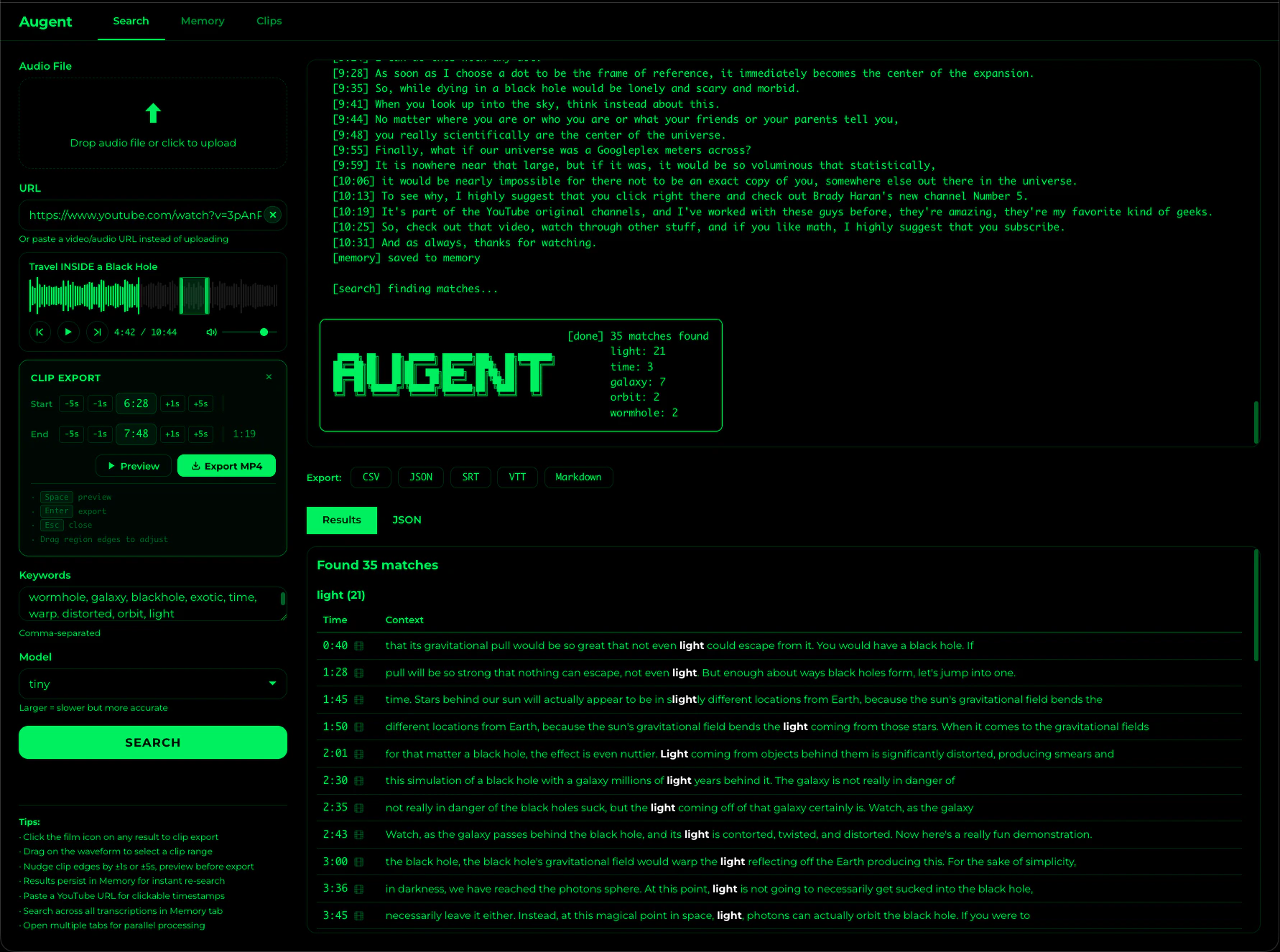
Upload an audio file or paste a YouTube/video URL directly. Enter keywords, select a model size, and click SEARCH. Results stream live with timestamps and context snippets.
File upload: Drag and drop or click to upload MP3, WAV, M4A, WEBM, and other audio/video formats
URL paste: Paste a YouTube or video URL to download and search audio without leaving the browser. Previously downloaded URLs are cached — pasting the same URL again skips the download entirely.
Waveform & playback: Both file uploads and URL downloads render an interactive audio waveform with play/pause, skip to start/end, and volume controls
Keywords: Comma-separated, matched against the transcription with surrounding context
Model selection: Choose from tiny (fastest, default) through large (maximum accuracy)
Live progress: A spinner animates during downloads and a progress bar tracks transcription in real time
Export: Results can be exported as CSV, JSON, SRT, VTT, or Markdown
Clip export: Click the film icon on any search result to visually select and export a video clip — see Clip Export below
Click the film icon on any search result. A green region appears on the waveform centered on that timestamp (±10 seconds). The clip toolbar opens below the waveform.
Once a region is selected, the clip toolbar provides full control:
Start / End displays: exact timestamps for each edge of the clip
Nudge buttons: ±1s and ±5s buttons on each edge for precise adjustment without dragging
Duration: live display of the clip length
Preview: plays only the selected region so you hear exactly what will be exported
Export MP4: downloads only the selected segment (not the full video) and saves to Desktop
Keyboard shortcuts: Space to preview, Enter to export, Esc to close
The region on the waveform is fully interactive — drag the edges to resize, drag the body to reposition. Only one clip region is active at a time.
The clip toolbar’s nudge buttons are the fastest way to fine-tune boundaries. Click the film icon on a result to get close, then use ±1s to dial in the exact cut.
Always preview before exporting. The preview plays only the selected range, so you hear exactly what the exported clip will contain.
When audio originates from YouTube, all timestamps in search results are automatically hyperlinked to the exact moment in the video. Click any timestamp to jump to that point on YouTube.How it works:
URL mode: Paste a YouTube URL and search. Timestamps are linked automatically.
File upload mode: If you uploaded a file that was originally from YouTube, a prompt appears in the results: “Know the YouTube URL?” Paste the URL and click Link timestamps to retroactively add clickable links to all results.
Persistent URLs: Source URLs from any platform (YouTube, Twitter/X, TikTok, Instagram, SoundCloud, etc.) are stored permanently by audio file hash. If the file was ever downloaded via MCP, CLI, or the web UI, any future search of that same file automatically links back to the original source — no manual entry needed.
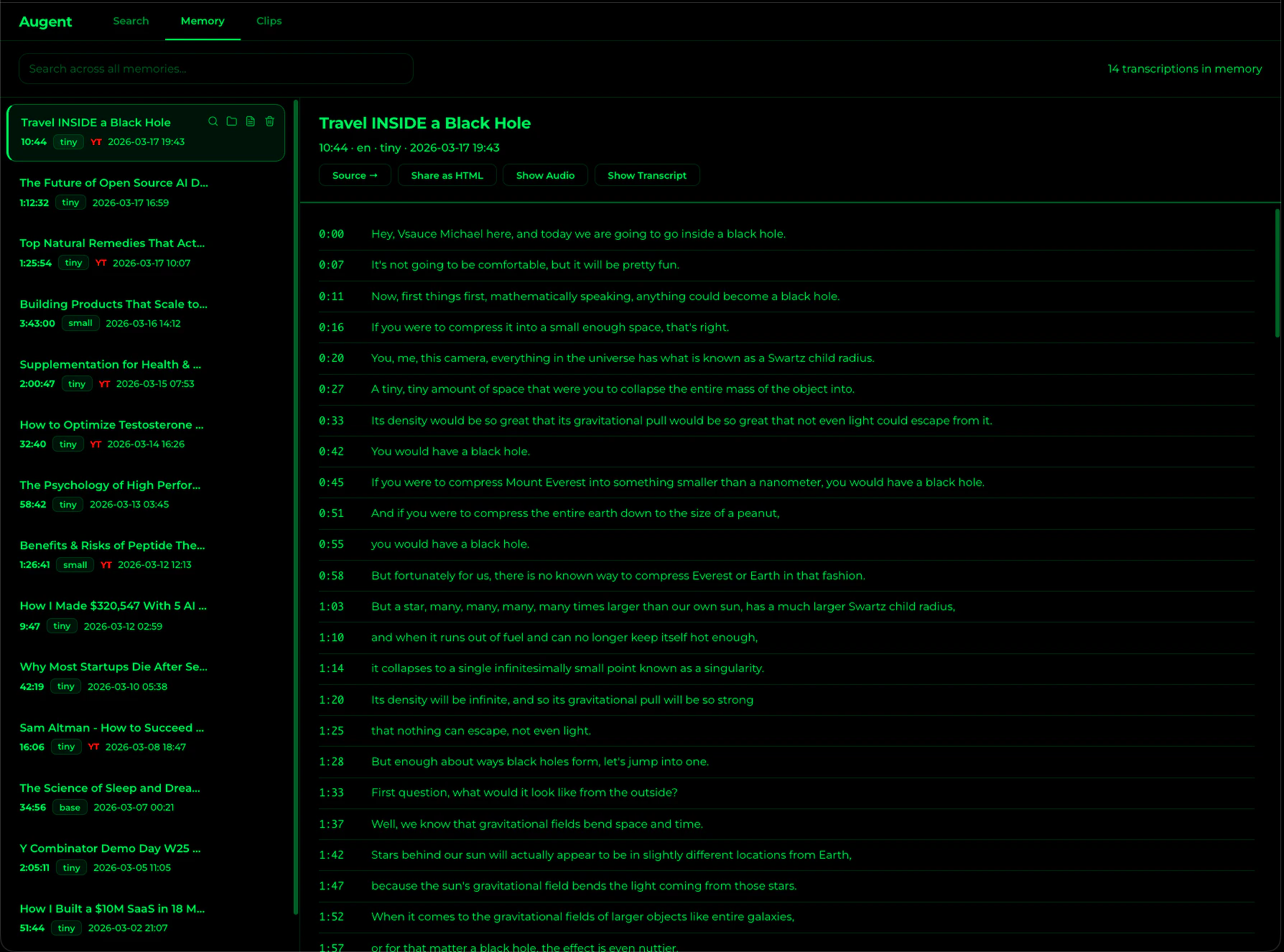
The Memory tab lets you browse, search, and manage everything Augent has ever transcribed — including files processed via MCP or CLI, not just the Web UI. All tools write to the same shared memory.
Reveals the .md transcript file in Finder. Available both on memory cards (document icon) and in the detail view alongside “Show Audio”. Drag the revealed file into a Claude Code session to run the full MCP pipeline (search, chapters, deep search, etc.) on a previously transcribed file.
Click a previously transcribed file in the Memory tab to search it again without re-uploading. The transcription is already cached — only the keyword search runs.
Download a self-contained HTML page of any transcript. The file includes all styling inline — no external dependencies. Share it with anyone, open it in any browser.
Type in the search bar to search across every transcription in your library by keyword — MCP, CLI, and Web UI transcriptions are all included. Results show matching segments with timestamps and the source transcription title.
After transcribing files via Claude Code or the CLI, open the Web UI to browse your entire library with a visual interface. Every transcription from any tool is already there — click to read, search, share, or delete.
Found something interesting hours ago but forgot the exact timestamp? Open the Memory tab, find the transcription, and search it again instantly. No re-upload, no re-transcription — the cached result is used.
Use Share as HTML to export any transcript as a self-contained web page. Send it to a colleague, client, or team member — they open it in any browser, no install needed.
Use Show Transcript to reveal a .md file in Finder, then drag it into a Claude Code session. This lets you run deep search, chapters, speaker identification, or any other MCP tool on content you transcribed days or weeks ago.